


70092 F4F-3A Wildcat.
- Add feedback:
- 70092
- Manufacturer: Arma Hobby
-
Availability:
Unavailable
Delivery time: December 2026
The first accurate F4F-3A Wildcat kit in 1/72 scale. All-new tooling by Arma Hobby, 2026.
F4F-3A Wildcat – Pre-Orders Open November 20!
Pre-orders for the 70092 F4F-3A Wildcat kit will open on Friday, November 20, 2026, at 7:00 PM Polish time (CET).
Don't want to miss the launch? Subscribe to the Arma Hobby newsletter to receive updates about our latest releases.
70092 F4F-3A Wildcat – 1/72 Scale
The latest release in Arma Hobby's Wildcat family represents one of the most interesting and lesser-known variants of this American fighter from the early years of World War II. Only 95 F4F-3As were built, but they served with both American naval aviation units and the British Fleet Air Arm.
Inside the box, you will find entirely new sprues developed in 2026, including grey plastic parts and a clear sprue with the canopy and the Arma Jig assembly aid. The kit also includes painting masks and high-quality decals printed by Cartograf in Italy.
Three Marking Options
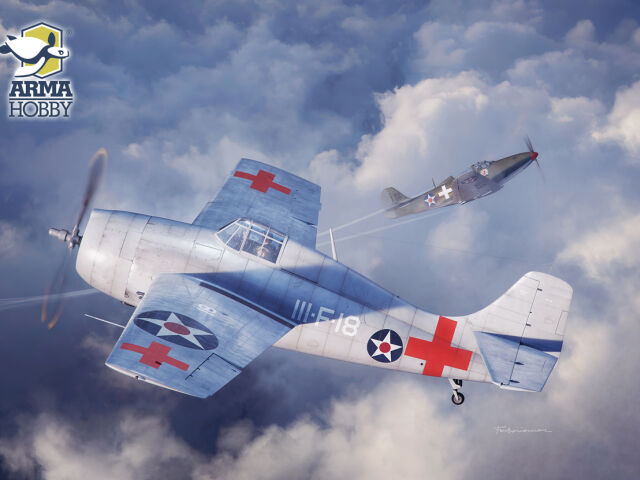
- F4F-3A III-F-18, VMF-111, US Marine Corps, November 1941 – An overall Light Gray Wildcat with enormous red crosses on the fuselage and wings, identifying the "Red Force" during the Carolina Maneuvers, just a few weeks before Pearl Harbor.
- F4F-3A F-14, BuNo 3914, VF-6, USS Enterprise, February 1, 1942 – The aircraft flown by Lieutenant Wilmer E. Rawie, who scored the first aerial victory by a US Navy fighter pilot in the Pacific War, shooting down a Japanese fighter over Taroa. Blue Gray over Light Gray camouflage with early-war national markings.
- Martlet Mk III AX736 "X", 805 Naval Air Squadron, Fleet Air Arm, North Africa, 1942 – A British Wildcat from a batch originally ordered by Greece. Desert camouflage in Dark Earth and Middle Stone with Light Gray undersides, based on Arma Hobby's interpretation of historical photographs.
History of the F4F-3A Wildcat
In 1940, the US Navy began re-equipping its fighter squadrons with the modern Grumman F4F-3 Wildcat. The aircraft featured a rugged airframe, four heavy machine guns, and a Pratt & Whitney R-1830-76 engine with a two-stage supercharger, providing good performance at high altitudes. However, production was hampered by difficulties in obtaining sufficient numbers of these complex engines.
Grumman therefore developed the F4F-3A variant, powered by the R-1830-90 engine with a simpler, single-stage, two-speed supercharger. It was a compromise: the simplified supercharging system reduced high-altitude performance but allowed production of additional fighters to continue. The engine cowling and air intake arrangement also differed in several details. The aircraft retained its non-folding wings and distinctive manually retractable landing gear.
Only 95 F4F-3As were built. Most went to American naval aviation units, but 30 aircraft were ordered for Greece, which was then fighting Italy. Before the fighters could reach their intended customer, the German offensive in April 1941 led to the defeat of Greece. The British took over the aircraft and designated them Martlet Mk III.
American F4F-3As entered service during the final months of peace. In the autumn of 1941, Marine pilots were still flying them in large-scale military exercises in the United States. Following the Japanese attack on Pearl Harbor, these fighters soon found themselves in combat against Japan.
On February 1, 1942, F4F-3As of VF-6 took part in a raid launched from the aircraft carrier USS Enterprise against Japanese positions in the Marshall Islands. During this operation, Wilmer Rawie scored the first aerial victory by a US Navy fighter pilot in the Pacific War. In a subsequent engagement, his Wildcat collided with a Japanese aircraft, and later all four of his machine guns jammed, leaving him unable to fire. Despite these difficulties, Rawie managed to return safely to the carrier.
Meanwhile, British Martlet IIIs served with 805 Naval Air Squadron, carrying out fighter and escort duties over North Africa. Instead of operating from aircraft carriers, they flew from desert airfields, where they received camouflage suited to local conditions.
The F4F-3A never became a major production variant. In US Navy service, it was soon superseded by later Wildcats, particularly the F4F-4 with folding wings. Nevertheless, this small production batch took part in the first American carrier offensives in the Pacific, while its British counterparts served in an entirely different theatre of war.
Arma Hobby 1/72 – More Models in Your Collection







 Message us on WhatsApp





 Polish