

Three New B-25 Mitchell Kits in 1/72 from Hobby 2000 – Available to Order Now!
The B-25 Mitchell – From the Doolittle Raid to Flying Batteries of Machine Guns
Three new Hobby 2000 B-25 Mitchell kits in 1/72 scale are now available to order from our shop. We expect them to arrive later this week. All three kits feature Hasegawa plastic parts and attractive marking options from the final years of the Second World War. It's a good opportunity to revisit the story of one of America's most versatile bombers.
From an Aircraft Carrier to the Pacific War
The B-25 Mitchell made history on 18 April 1942, when sixteen early B-25B bombers took off from the aircraft carrier USS Hornet to attack Japan. The famous raid led by Lieutenant Colonel James Doolittle caused relatively limited material damage, but its psychological impact was enormous. After months of Japanese victories, the Americans demonstrated that they could strike the Japanese home islands themselves.
The choice of the B-25 was no accident. The twin-engined Mitchell offered the necessary range and bomb load, but above all, it had excellent short-field take-off characteristics. These made it capable of a mission that would have been impossible for most other American bombers.
The same qualities would prove extremely valuable during the subsequent fighting in the Pacific.
Why Was the Mitchell So Successful in the Pacific?
The Pacific War demanded aircraft capable of operating from improvised island airfields, often with short runways and limited maintenance facilities.
The Americans had two modern medium bombers: the North American B-25 Mitchell and the Martin B-26 Marauder. The Marauder was a fast, well-armed aircraft, but it required longer runways and was more demanding to fly. The Mitchell was more practical under these conditions and gradually became the principal American medium bomber in the Pacific, while the B-26 found its main role in Europe and the Mediterranean theatre.
Initially, the B-25 was a conventional medium bomber, designed primarily for level bombing. Combat experience soon demonstrated, however, that it could be a far more versatile aircraft.
Glazed Nose or a Battery of Machine Guns?
Early Mitchells featured a glazed nose housing the bombardier's position. This arrangement was retained on many later B-25Js, allowing them to carry out conventional bombing missions against bridges, railway lines and military installations. These aircraft played an important role not only in the Pacific, but also during the Italian Campaign.
In the Pacific, however, a different approach to aerial warfare emerged. American crews began attacking Japanese ships, barges, airfields and military positions at low altitude. For these missions, forward-firing machine guns proved far more useful than a bombardier's compartment.
Initially, aircraft were modified in the field, but purpose-built versions soon followed, featuring a solid, unglazed nose packed with heavy .50-calibre (12.7 mm) machine guns. Combined with additional guns mounted along the sides of the fuselage, late Mitchells could carry as many as fourteen forward-firing machine guns.
Equipped in this way, the bomber became a formidable ground-attack aircraft. Its crews could strafe a target with machine-gun fire before releasing their bombs. The Mitchell proved particularly effective against Japanese shipping and transport.
The aircraft also served with the United States Marine Corps, where it received the designation PBJ-1. Some Marine Corps Mitchells were fitted with search radar, enabling them to locate ships at night and in poor visibility.
Three New Mitchell Kits from Hobby 2000
The latest Hobby 2000 releases illustrate three different faces of the late-war Mitchell.
PBJ-1J Mitchell (72090) represents aircraft operated by the US Marine Corps. The kit offers four marking options: three aircraft with glazed noses and one with a solid nose armed with machine guns. An additional 3D-printed underwing radar housing makes this release particularly interesting. The markings cover aircraft serving in Hawaii, the Philippines, Cherry Point and Emirau.
B-25J Mitchell Solid Nose (72091) depicts the classic strafing Mitchell with its heavily armed solid nose. Two marking options represent aircraft operating in the Philippines and from Okinawa in 1945. These were the types of aircraft that became synonymous with American low-level attack operations in the Pacific.
B-25J Mitchell Glazed Nose (72092) represents the conventional bomber version, retaining the glazed bombardier's compartment. Its three marking options depict USAAF aircraft operating from Corsica and Italy during 1944–1945. They remind us that the Mitchell also played an important role in the Mediterranean air war, particularly in attacks against German transport and communication networks.
All three kits contain Hasegawa plastic parts, but differ in aircraft configuration, additional components and markings. Together, they offer an excellent opportunity to build a small collection illustrating the remarkable versatility of the North American B-25 Mitchell.
All three kits are now available to order from Arma Hobby. We expect them to arrive later this week.
Choose your Mitchell from the selection below!
Featured products

H2K72090 PBJ-1J Mitchell.

H2K72091 B-25J Mitchell Solid Nose.

H2K72092 B-25J Mitchell Glazed Nose.

H2K72057 B-26B/C Marauder!

H2K72058 B-26B Marauder!

H2K72070 - B-29 Superfortress - ACADEMY + CARTOGRAF + MASKs

HTK-AS04 US Army Air Force paint set of 6

HTK-CS04.2 US Army Air Force paint set!

HTK-BS04.2 US Army Air Force paint set of 6 x 17 ml
Featured articles
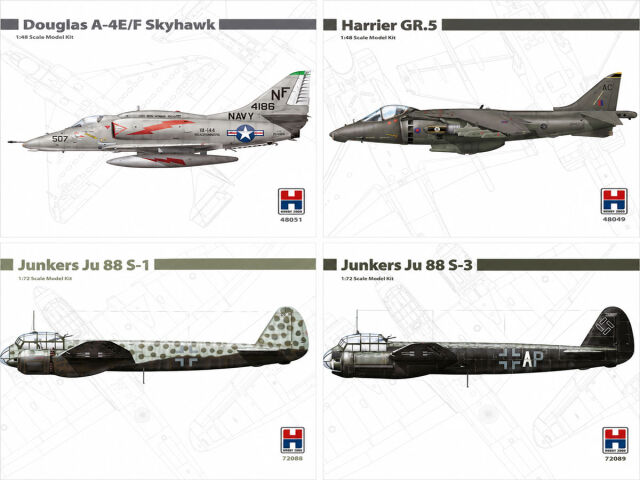
New Hobby 2000 Releases – Harrier, Skyhawk and the Fast Ju 88s

New Hobby 2000 delivery – He 162 and the new K2 in Polish unit markings now in stock

 Polish