
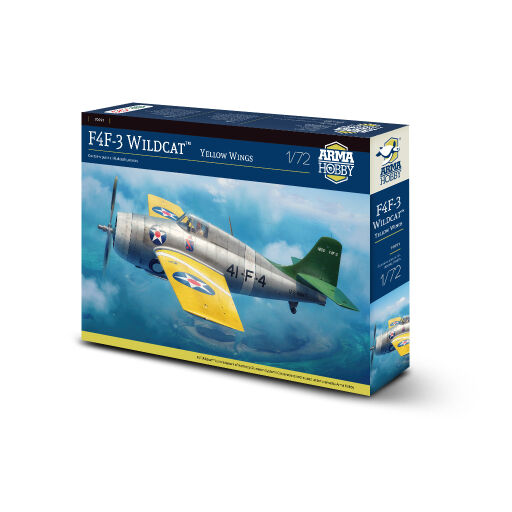


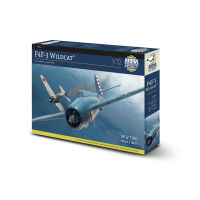
70091 F4F-3 Wildcat™ "Yellow Wings".
- Add feedback:
- 70091
- Manufacturer: Arma Hobby
-
Availability:
In Stock
Delivery time: third week of September 2026
- szt.
- Net Price: €16.46 €20.24
- This product is available for pre-order - dispatch times will be more than 7 days for regular orders.

F4F-3 Wildcat™ “Yellow Wings” 1/72 – 70091
The Grumman F4F-3 Wildcat entered US Navy service at a time when American carrier aircraft still wore some of the most colourful markings in aviation history. Kit 70091 features early-production Wildcats with yellow wings, colourful tail surfaces and distinctive section markings.
Arma Hobby’s 1/72 scale F4F-3 Wildcat™ was designed from the ground up to represent the early, fixed-wing version of the Wildcat. The kit takes into account differences between F4F-3 production batches, including variations in the engine cowling and cockpit glazing. The Wildcat’s distinctive landing gear has been engineered for straightforward and precise assembly.
Kit contents
- plastic parts for a 1/72 scale F4F-3 Wildcat™,
- alternative parts for the appropriate early F4F-3 production variants,
- decals for two colourful pre-war US Navy marking options,
- masks for the canopy and wheels.
Marking options
- Grumman F4F-3 Wildcat BuNo 1850, 41-F-4, VF-41, USS Ranger (CV-4), 1940 – one of the first production Wildcats. Aircraft No. 4 was the leader of the squadron’s second, or “white”, section, so the cowling ring, fuselage band and wing chevrons were painted white with thin black outlines. The green tail surfaces indicated assignment to USS Ranger. Factory photographs show the aircraft earlier with the transitional code 4-F-4: VF-4 was being redesignated VF-41 at the time, and the “1” was added to the code later.
- Grumman F4F-3 Wildcat BuNo 1880, 72-F-16, VF-72, USS Wasp (CV-7), 1940–1941 – leader of the squadron’s sixth, or “yellow”, section. The yellow cowling ring, fuselage band and wing chevrons identified the section leader, while the black tail surfaces indicated assignment to USS Wasp. The aircraft carried full VF-72 markings, including the squadron’s distinctive insignia. Period photographs of VF-72 Wildcats also show the telescopic gunsights projecting through the windscreen.
Free 3D file for printing F4F-3 accessories (download code included in the instructions)
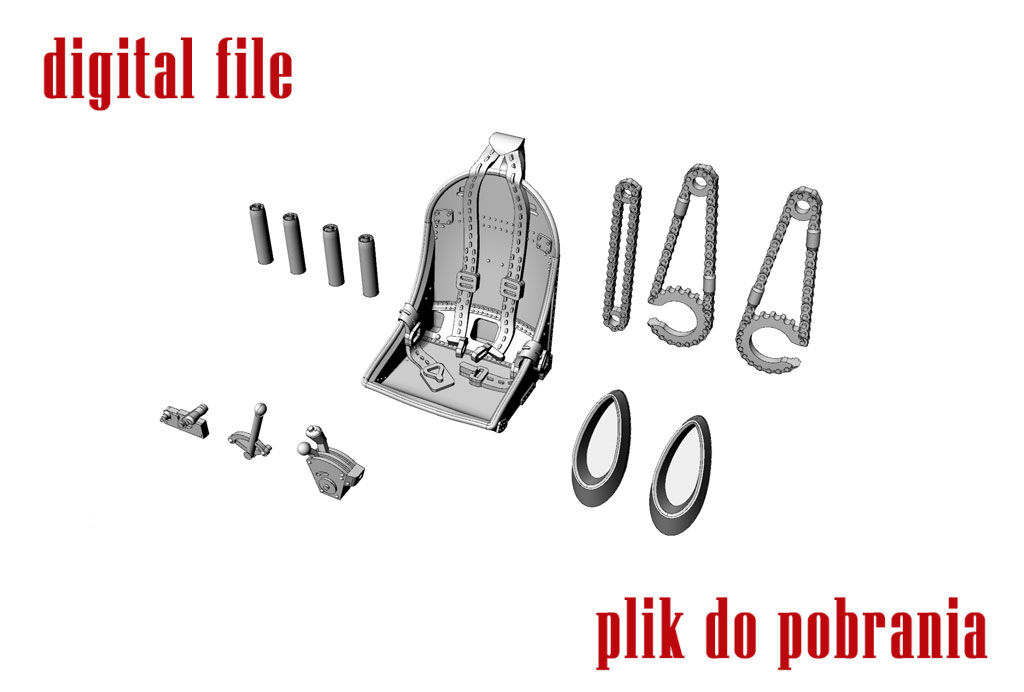
- Includes: seat with harness, exhaust pipes, landing gear operating chains, cockpit levers and gun barrels.
- File for home printing on a resin 3D printer. Consumer licence for non-commercial use only.
- See §4a of the terms and conditions governing the use of 3D files here.
The Last Days of the Golden Age
The Grumman F4F-3 Wildcat entered US Navy service in 1940, while the United States was still officially outside the war. The modern fighter quickly began replacing older types in carrier-based squadrons. Early aircraft retained telescopic gunsights, which were soon replaced by more modern reflector sights.
F4F-3s served aboard carriers including USS Ranger (CV-4) and USS Wasp (CV-7), whose aircraft took part in Neutrality Patrols over the Atlantic. American ships and aircraft monitored the activities of the German Kriegsmarine and patrolled the shipping lanes while the United States formally remained outside the war. Atlantic Fleet Wildcats of this period carried distinctive national markings: stars on both the upper and lower surfaces of the wings, together with an additional star unusually positioned on the forward fuselage.
These were the last days of the golden age of colourful US Navy aircraft markings. The airframes were finished in modern aluminium paint formulated to withstand the harsh conditions of naval service and protect the structure against corrosion. The upper surfaces of the wings were painted bright yellow to improve visibility – particularly important when searching for an aircraft forced down at sea. Colour-coded tail surfaces indicated the carrier to which the aircraft was assigned, wing chevrons helped pilots maintain formation, and colourful fuselage markings identified each aircraft’s position within its section.
The aircraft were carefully maintained, clean and strikingly marked – as befitted the fleet of a nation still at peace. War would soon bring this riot of colour on American combat aircraft to an end.





 Message us on WhatsApp


 Polish