
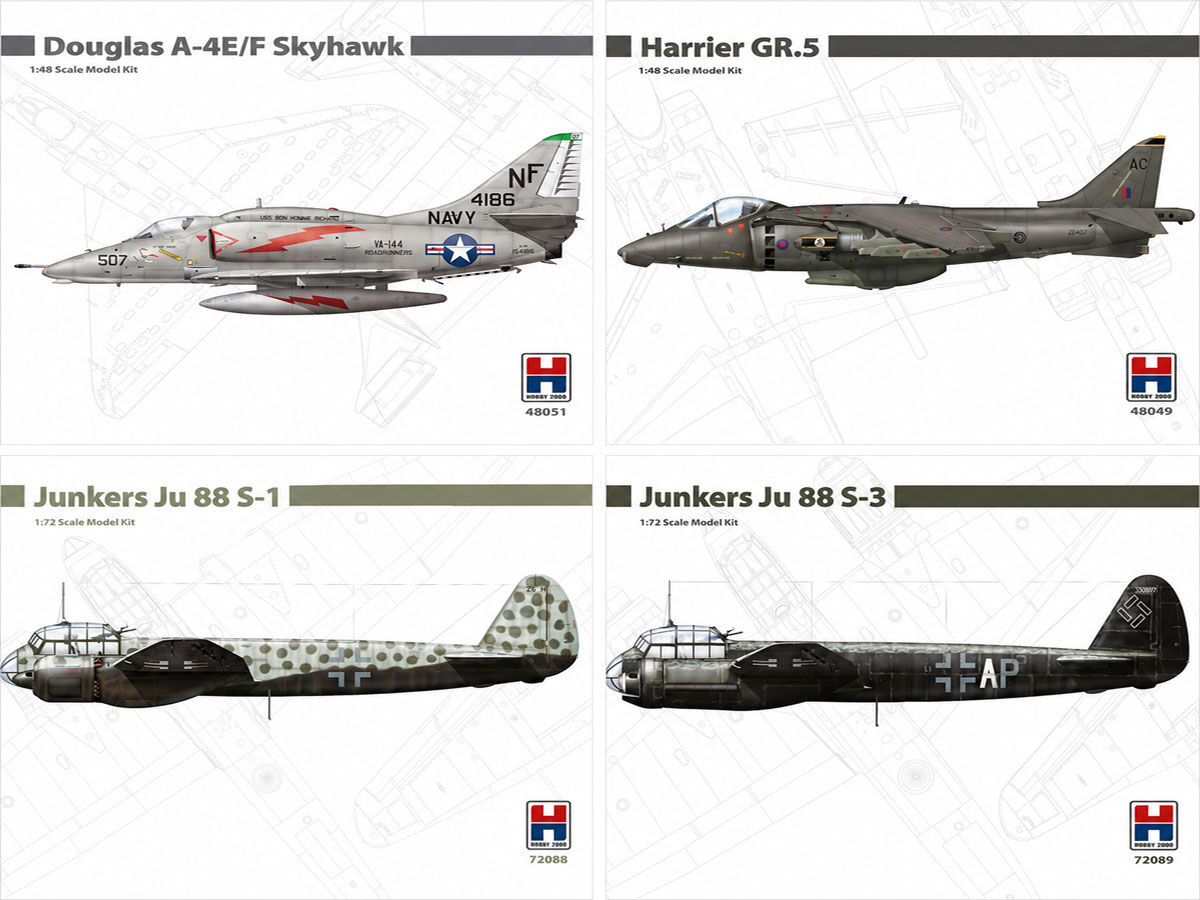
New Hobby 2000 Releases – Harrier, Skyhawk and the Fast Ju 88s
Some deliveries are built around one obvious headline release. This one is different. The four new Hobby 2000 kits form a much more interesting story, stretching from specialised Ju 88 variants of the final years of World War II to the Harrier and Skyhawk – aircraft that defined strike aviation in very different ways during the decades that followed.
There is also something that connects all four kits from a modeller’s point of view. Hobby 2000 has taken proven Hasegawa plastic parts and combined them with Cartograf decals, painting masks and new marking selections. The result is not just the return of familiar kits, but releases that give a good reason to look at them again.
Harrier GR.5 1/48 – before the Harrier turned grey
The Harrier GR.5 tends to live in the shadow of the later GR.7 and GR.9. That is a pity, because it was the aircraft that opened the British chapter of the second-generation Harrier story.
By the late 1980s the RAF was receiving an aircraft that was significantly different from the first-generation Harrier. The central idea remained the same – short and vertical take-off and landing – but the new wing and developed airframe made it a new-generation combat aircraft.
From a modelling point of view, the GR.5 has another major advantage: it belongs to the period before British Harriers became associated mainly with shades of grey.
Hobby 2000 48049 Harrier GR.5 1/48 offers four RAF aircraft from 1990–1991: examples from No. 3 Squadron, No. 233 OCU and two No. 1(F) Squadron aircraft that took part in Red Flag exercises at Nellis AFB. The two-tone green camouflage and individual markings of the Red Flag machines give the aircraft a very distinctive late-Cold War character.
The box includes Hasegawa plastic parts, Cartograf decals and painting masks.
A-4E/F Skyhawk 1/48 – KISS according to Ed Heinemann
The Skyhawk was created around a design philosophy closely associated with Ed Heinemann: KISS – Keep It Simple, Stupid. Do not add complexity unless it is really needed. A combat aircraft should be as small, light and straightforward as possible, while still doing exactly what it was designed to do.
The A-4 became almost a textbook example of that approach. It was compact enough to avoid the need for folding wings aboard an aircraft carrier, yet still capable of carrying an impressive combat load. Simplicity did not mean primitiveness – it meant removing everything that did not need to be there.
The result was an aircraft that found itself at the centre of the Vietnam War and remained in service for decades.
Hobby 2000 48051 Douglas A-4E/F Skyhawk 1/48 shows the Skyhawk from exactly that key combat period. The box includes four marking options: VA-144 “Roadrunners” from USS Bon Homme Richard, VA-155 “Silver Foxes” from USS Coral Sea, VMA-311 “Tomcats” from Chu Lai, and another striking Roadrunner aircraft from USS Kitty Hawk.
The classic grey-and-white US Navy finish also belongs to a period when squadrons were not afraid of colour. Each of the four Skyhawks has a strong individual identity and is immediately distinguishable from the others.
The kit is based on Hasegawa plastic parts, supplemented with Cartograf decals and painting masks.
Ju 88 S – when speed was supposed to be the bomber’s defence
The other two releases take us two decades earlier and show a less obvious side of the Junkers Ju 88 story.
The Ju 88 is usually associated with the conventional bomber, night fighter or reconnaissance aircraft. The Ju 88 S series went in a different direction. The idea was straightforward: reduce weight and defensive armament, improve aerodynamics and, instead of trying to fight intercepting fighters, try to outrun them.
It was a response to a situation in which the Luftwaffe was finding it increasingly difficult to operate freely over Western Europe.
For the modeller, the story becomes even more interesting with KG 66. Aircraft of this specialised night and navigation unit carried finishes that were often far removed from the standard image of Luftwaffe camouflage.
Ju 88 S-1 1/72 – four aircraft, four interpretations of camouflage
Hobby 2000 72088 Junkers Ju 88 S-1 1/72 contains four aircraft of 1./KG 66 operating from France in late 1943 and the first half of 1944: Z6+NH, Z6+AH, Z6+BH and Z6+GH.
On paper, the subject is very coherent – one unit, one aircraft type and a relatively short time period. Visually, it is quite the opposite.
Dark lower surfaces, irregular blotches and disruptive patterns applied over lighter colours make the individual aircraft look almost like separate studies in how to hide a large bomber in the night sky.
This is one of those kits where choosing the camouflage option may take longer than deciding to buy the model.
The box includes Hasegawa plastic parts, Cartograf decals and painting masks.
Ju 88 S-3 1/72 – the Luftwaffe at the end of the war
Hobby 2000 72089 Junkers Ju 88 S-3 1/72 continues the story into the second half of 1944 and the beginning of 1945.
Four aircraft associated with KG 66 are included: Z6+BH from Celle, Z6+HL from Le Culot, Z6+CL from Dedelstorf and L1+AP from Chièvres.
Here the camouflage becomes even more unusual. Z6+BH, with its dense, winding pattern, is especially striking and looks very different from the standard image of a German bomber. It is the kind of scheme that demands some careful airbrush work, but that can also become the main reason for building the model.
As with the S-1, Hobby 2000 combines Hasegawa plastic parts with Cartograf decals and painting masks.
Four kits, but not four random reissues
What makes this delivery interesting is the choice of subjects.
The Harrier GR.5 captures a short and very distinctive moment in the transition to the second-generation Harrier. The A-4E/F Skyhawk returns to the most important combat period of the type and at the same time shows how effective Heinemann’s KISS philosophy could be when applied by a great designer. The Ju 88 S-1 and S-3 show a less familiar attempt to turn a large bomber into an aircraft whose main protection was supposed to be speed – and they add some of the most interesting late-war Luftwaffe camouflage schemes to the mix.
That is what a good reissue should do: not simply make a familiar kit available again, but give you a reason to want to build it now.
Featured products
H2K48049 Harrier GR.5.
H2K48051 Douglas A-4E/F Skyhawk
H2K72088 Junkers Ju 88 S-1.
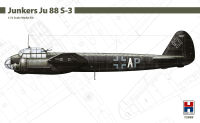
H2K72089 Junkers Ju 88 S-3.
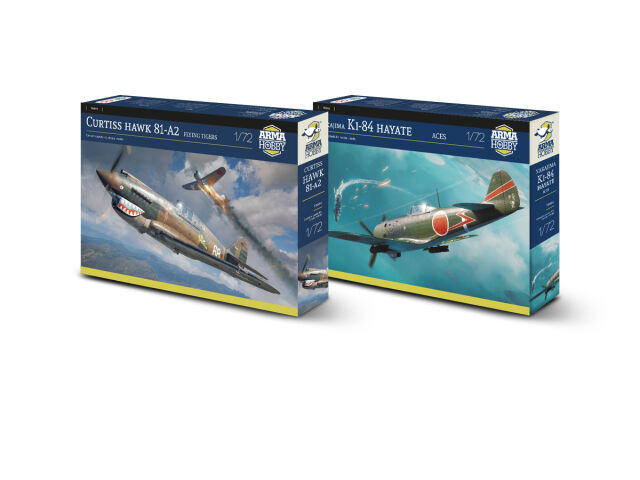
70094 Curtiss Hawk 81-A2.
70066 Nakajima Ki-84 Hayate "Aces".
Featured articles
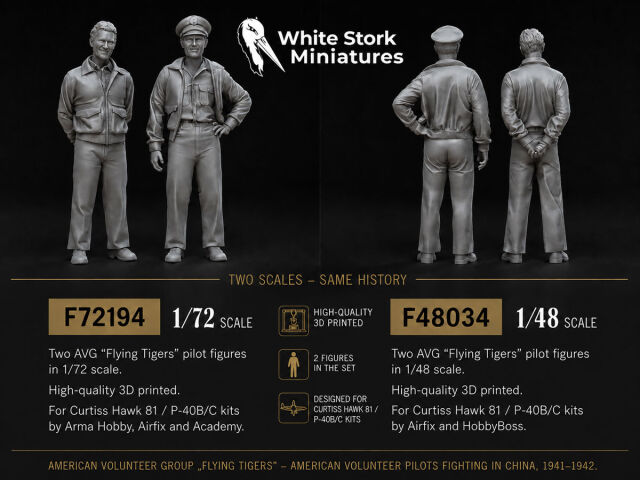
Flying Tigers Pilots Figurines 1/72 i 1/48
 Polish